




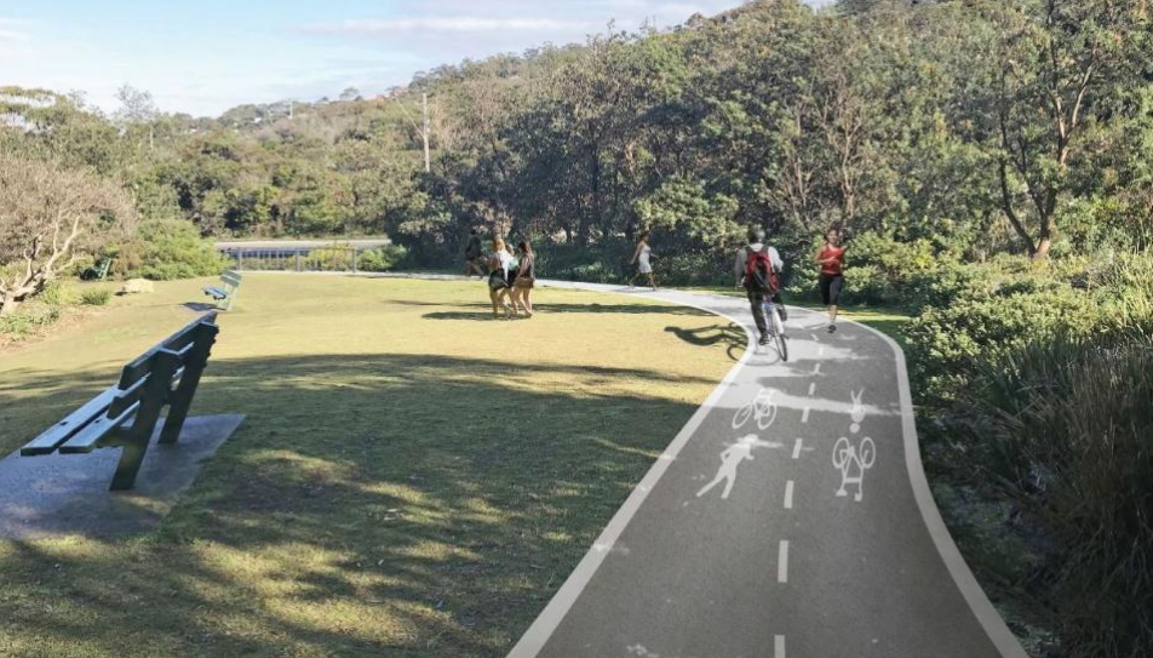
Newport residents have a new way to walk and cycle towards Bilgola without travelling alongside traffic on the winding Bilgola Bends. But just days after the long-awaited shared path opened, concerns have emerged about how safely pedestrians and faster-moving e-bikes can use the same route.
The 750-metre connection, officially opened on 13 October 2026, runs alongside Barrenjoey Road between Newport Beach and The Serpentine at Bilgola Beach. Approximately three metres wide, it provides an off-road route for pedestrians and cyclists, while adding another section to the Northern Beaches coastal walking network.
For locals, the improvement is substantial. Travelling between Newport and Bilgola has long meant negotiating steep terrain or using routes close to one of the area’s busiest coastal roads. The new path offers an alternative, with boardwalk sections, lookout points and native landscaping along the route.
Northern Beaches Mayor Sue Heins welcomed the new connection, describing it as a lasting addition to the area’s coastal walking network.
“The new pathway provides a safer and more accessible route for walkers, bike riders and people with mobility limitations, while showcasing the incredible beauty of our coastline,” Mayor Heins said.
Nearly a Decade from Funding to Opening
The project has a lengthy history, beginning with a $2.6 million NSW Government funding announcement in 2017. Community consultation followed in 2020, with further design work undertaken before Council approved the final plans in November 2024.
Construction began in September 2025, incorporating an elevated pathway through sections of the coastal landscape, non-slip surfaces, handrails and connections to existing walking infrastructure.
At the Newport end, the new route links with the Bicentennial walkway near the beach car park. At The Serpentine, cyclists can transition onto the adjoining road, while pedestrians can continue towards Bilgola Beach using the existing walkway and stairs.
Although the completed connection improves access along this section of coastline, the steep terrain means the entire route does not meet compliant accessibility gradients. Council has acknowledged this limitation while noting the improvements made for people using mobility aids.
The pathway also contributes to the broader coastal corridor linking Newport, Bilgola and Avalon, although other sections of the network remain to be completed.
The Downhill Speed Concern
While the new path separates cyclists from traffic on Barrenjoey Road, its shared use by pedestrians and riders has prompted questions about speed, particularly on downhill sections.
Pittwater MP Jacqui Scruby, who attended the opening alongside Northern Beaches Mayor Sue Heins, councillors, Council staff and Newport Residents Association representatives, has called for additional speed-reduction measures.
Her concern centres on the growth in electric bicycle use since the project’s earlier consultation, and whether the original design adequately accounts for the different speeds of people now using shared pathways.
“Since 2020 we’ve had an explosion in e-bike uptake, fundamentally changing the use of the path from how it was contemplated by designers and the community in 2020,” Ms Scruby said in a statement issued on 14 October.
She has urged Council to consider engineered speed-reduction measures and an enforceable speed limit, while indicating that she intends to reintroduce legislation addressing speeds on shared pathways.
The issue extends beyond electric bicycles. Conventional bicycles can also gather considerable speed downhill, while walkers, families with young children and people using mobility aids may travel much more slowly.
There have been no confirmed reports of collisions on the newly opened Newport–Bilgola section in the information reviewed for this article. The concerns relate to potential risks as the pathway begins attracting regular users.
Pedestrians Have Right of Way, but What About Speed?
Under NSW road rules, cyclists and riders of legal e-bikes must give way to pedestrians on shared paths, keep left and ride at a speed appropriate to the conditions.
For legal pedal-assist e-bikes, motor assistance must cut out at 25 km/h. That threshold does not prevent a bicycle from travelling faster through pedalling or downhill momentum, and it should not be confused with an actual speed limit.
Nor does NSW impose a general 10 km/h speed limit on bicycles using ordinary shared paths. Different rules apply to certain other devices and designated shared zones.
Ms Scruby has raised concerns that riders may legally travel at speeds approaching the adjoining road’s 50 km/h limit, despite sharing the pathway with pedestrians. However, the absence of a separate blanket shared-path speed limit does not remove cyclists’ obligations to give way, ride safely and adjust their speed to the conditions.
For people walking along the route, particularly during busy beach weekends, the practical concern is whether approaching riders have sufficient visibility and stopping distance to avoid collisions.
Council’s Safety Measures Face Their First Test
Northern Beaches Council has already incorporated several safety features into the pathway, including blue shared-path markings and ‘Slow’ warnings at potential conflict points. Handrails and non-slip surfaces have also been included in the design.
These measures are intended to help different users navigate the route, although their effectiveness under heavier pedestrian and cycling traffic has yet to be established.
Sharing the Newport–Bilgola Path: What Residents Should Know
Pedestrians, cyclists, legal e-bikes and people using mobility aids.
Cyclists must give way to pedestrians.
No, not under ordinary NSW shared-path rules.
Yes, but legal pedal-assist motor assistance must cut out at 25 km/h.
Blue shared-path markings, ‘Slow’ warnings, handrails and non-slip surfaces.
Not to compliant accessibility gradients throughout, because of the steep terrain.
The opening marks an important improvement for Newport residents who previously had limited off-road options for travelling towards Bilgola. It also creates a new shared public space where pedestrians and cyclists will need to accommodate one another, particularly on steeper sections.
For those who prefer a walking-only route, the upgraded coastal pathway through the bush and along the ocean remains another option.
Council is continuing work on other coastal connections, including planned improvements around Bilgola Beach and Allen Avenue, with further construction anticipated in 2027–28.
For now, the Newport–Bilgola shared path is open, providing a long-awaited alternative to the Bilgola Bends. Whether its existing safety measures are sufficient, or additional speed controls become necessary, will be an important question as the route sees more use over the coming summer.
Published 15-October-2026